


The sale of industrial marking machines is highly relevant in an increasingly competitive business environment. These systems have the ability to identify and track products throughout the entire supply chain, which is essential to ensure quality, safety, and efficiency in production processes.
Keep reading to discover with COUTH the latest innovations in industrial marking and traceability technologies, their applications, and the benefits they offer to companies.
What Are Industrial Marking and Traceability Machines?
Industrial marking and traceability machines are systems designed to identify, mark, and track products throughout their life cycle in the supply chain. These tools are essential across various industries because they enable quality control and ensure compliance with specific regulations.
At COUTH, we specialize in the development of marking equipment and offer the most comprehensive sale of industrial traceability machines.
- These machines apply crucial information to products such as barcodes, QR codes, serial numbers, and manufacturing dates.
- They enable quick and accurate product identification, essential in high-production environments.
- They allow for marking customization, adapting to the specific needs of each product or client.
Types of Industrial Marking Machines by Need
At COUTH, we offer the most advanced technology in industrial marking and traceability systems, including dot peen marking, scribing, and laser marking machines that adapt to various business needs.
Dot peen marking
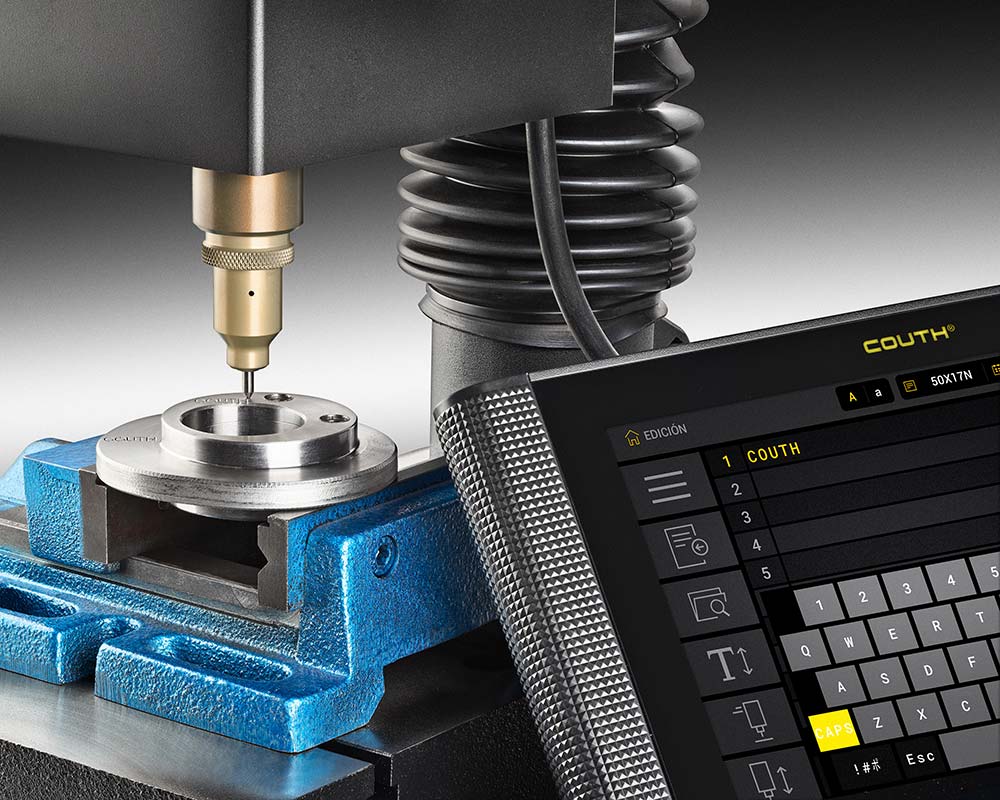
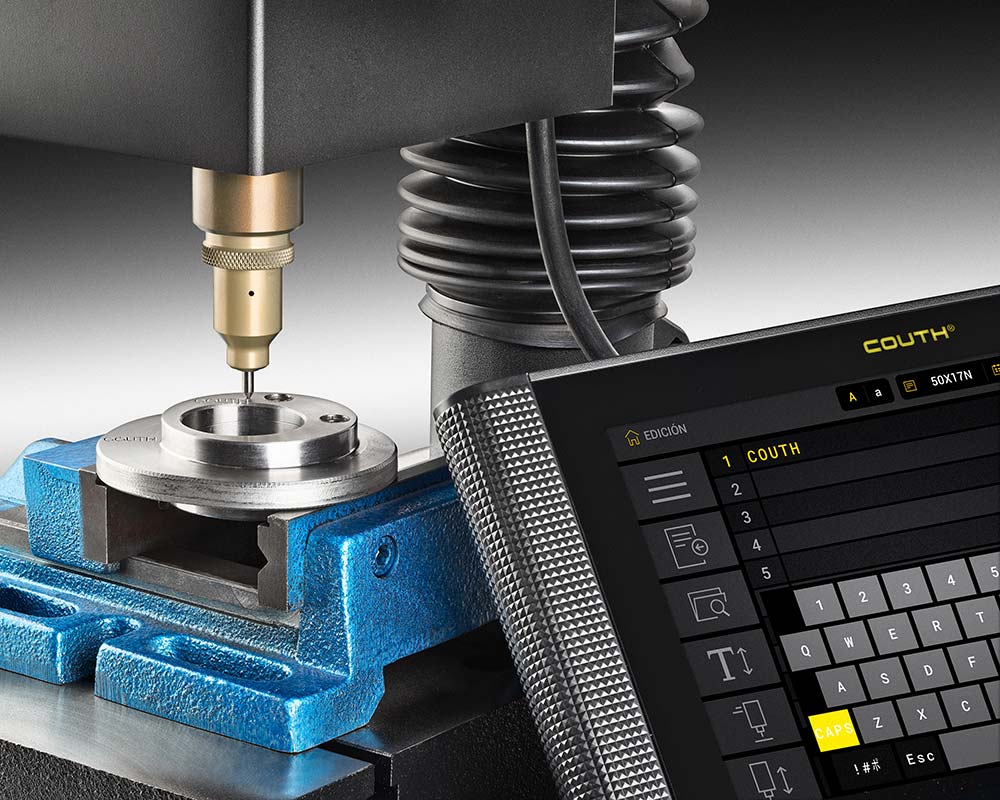
Dot peen marking is an advanced technique used in industry to create permanent, readable marks on a wide variety of materials. COUTH has developed innovative solutions that leverage this technology to meet customer needs in different industrial sectors.
Features:
- Durability: Marks produced by micro-percussion are resistant to wear, corrosion and harsh environmental conditions, making them ideal for applications in demanding environments.
- Accuracy: This method allows for high precision markings, including alphanumeric codes, serial numbers and logos, ensuring that the information is legible and clear.
- Versatility: Micro-percussion marking can be applied to a wide range of materials, including metals, plastics and ceramics, making it a flexible option for a variety of industries.
- No consumables: Unlike other marking techniques, micro-percussion does not require ink or other consumables, reducing operating costs and maintenance.
Scribing
Scribing is a technique that creates permanent marks through incisions or scoring. At COUTH, our scribing solutions are ideal for applications requiring precise, durable, and quiet markings, complying with EU Directive 2003/10/EC.
Features:
- Permanent markings: Marks made by scribing are extremely durable and do not wear over time, ensuring legibility throughout the life of the product.
- High precision: This method allows the creation of fine and detailed marks, which are essential for the correct identification and traceability of products.
- Diversity of materials: Scratch marking can be applied to a wide range of materials, including metals, plastics and ceramics, making it versatile for different industrial sectors.
- No consumables: Like micro-percussion marking, scribing does not require ink or other consumables, resulting in cost savings in the production process.
- Quiet marking: The noise level of the machine is 25% quieter than the demanding European standards.
Laser marking
Laser marking is one of the most advanced and precise methods for product identification and traceability. COUTH offers high-efficiency, versatile, and high-quality laser marking solutions. This technology creates permanent marks without physical contact with the material.
Features:
- Millimeter accuracy: Laser marking allows engraving and marking with exceptional precision, which is crucial for barcodes, serial numbers and logos.
- Permanent marks: Laser-generated marks are resistant to abrasion, corrosion and environmental conditions, ensuring legibility over time.
- Material versatility: This technique can be applied to a wide range of materials, including metals, plastics, wood and glass, making it suitable for a variety of industrial applications.
- No consumables: Laser marking eliminates the need for ink and other consumables, reducing operating costs and maintenance.
Industries That Use Our Marking Solutions
Our industrial marking and traceability equipment is widely used in:
- Automotive: Traceability and industrial marking systems play a crucial role in this sector, ensuring component and individual vehicle identification, production traceability, regulatory compliance, quality control and supply chain management.
- Aeronautics: Traceability and industrial marking systems play a key role in managing the production, maintenance and regulation of aeronautical components.
- Railway: Industrial marking and traceability equipment is essential in the railway sector, guaranteeing quality, safety and efficiency at every stage of the process.
- Oil and gas: Industrial marking and traceability systems are crucial in this sector, guaranteeing quality, safety and efficiency at every stage of the process.
- Steel: Traceability and industrial marking are crucial in this industry to ensure quality, safety and efficiency in production.
Use cases and applications
Marking of Metal Parts
In the steel industry, marking metallic products such as rods, sheets, and tubes is essential for identification and tracking. The parts are marked with information about their chemical composition and mechanical properties, which allows:
- Ensuring that the parts meet the required specifications for their intended use.
- Tracking the material from production to delivery, facilitating inventory management.
Engraving of Serial Numbers, Batches, and QR Codes
In the automotive industry, each metal component—from chassis to engine parts—must be uniquely identified. Using laser or dot peen marking techniques, serial numbers, barcodes, and quality symbols are engraved on the parts. This allows:
- Tracking each component from its production to installation, ensuring safety standards are met.
- Facilitating audits and ensuring parts comply with required specifications.
Traceability of Industrial Components
For example, in the electronics industry, component traceability is crucial for product management and quality assurance. Each component is marked and tracked through:
- Identification labels, allowing manufacturers to follow the product flow from production to sale.
- Inventory management systems that help optimize production and reduce waste.
How to Choose the Right Marking Machine
Below are some key factors to consider when purchasing industrial marking and traceability equipment:
1. Type of Material to Be Marked
The first step is to identify the type of material you need to mark. Different marking technologies are better suited to certain materials. For example, for metals such as stainless steel or aluminum, laser or dot peen marking is recommended.
2. Durability and Legibility Requirements
The durability of the mark is essential, especially in industrial environments where parts may be exposed to harsh conditions.
3. Production Speed
The speed at which you need to mark parts is a critical factor. Some machines are faster than others:
- Laser marking machines: Typically fast and efficient, ideal for high-speed production lines.
- Dot peen marking: While potentially slower, it offers high precision and is ideal for deep, long-lasting marks.
4. Ease of Use and Maintenance
Consider how easy the machine is to operate and maintain. Look for machines with intuitive interfaces that simplify programming and daily use.
For example, laser machines usually have fewer moving parts and therefore require less maintenance.
5. Total Cost
Evaluate not only the initial cost of the machine but also the total cost of ownership, which includes:
- Operating costs and return on investment (ROI).
6. Compatibility with Traceability Systems
Ensure the marking machine integrates well with your existing traceability systems. This includes connectivity and customization capabilities.
If you’re looking for the best option in industrial marking machine sales, COUTH is your best ally. Don’t wait—contact us and we’ll help you select the right solution based on your needs.
